


Avoid Left-Right Confusion with Bi-Color Shoelaces

Pinned to SHOETYING: http://ift.tt/2hZDnc4


Visual Warm-Ups to Improve Reading Skills
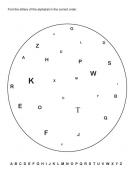 One of the first requirements of reading is the actual use of the eyes and coordination of the muscles. Just as you do warm-ups and stretches before exercising, do some exercises with the eyes before reading. Eyes are controlled by muscles. These can be strengthen and trained to work more efficiently.
A. "Look to the extremes": Up, Down; Left; Right; Top to bottom centered; then top to bottom on the right; Top to bottom on the Left; Bottom to top on the right; Bottom to top on the left; Quickly look from top left to bottom right (diagonal); Top Right to bottom left; Bottom right to top left; Bottom left to top right (diagonal)
B. "Eyes Jumps": Focus on an object about 10' away, then quickly shift to an object much closer but within the same visual pane; (ie the clock on the wall then the back of the students head in front of you) go back and forth several times. Then from a far object to a near object on a different visual plane (ie from the clock again to your hand on the desk) -No head tilting allowed only eye movements!
Feeling warmed up yet?
C. Visual Scanning Exercise: this is another way to get those eyes moving and ready to read.

1. Find each letter in alphabetical order that are randomly placed in circle.
2. Find the letters or numbers in the order listed. Place the circle search page next to the "look up" page on the desk to practice side by side scanning. This keeps the eyes in the same visual plane.
3. Find the letters on numbers in the order listed. Place the circle search page vertically several feet away (tape to a wall or chalk board). This makes the eyes change planes, going from horizontal to vertical.
Other Things to Consider:
1. Acuity: How are the lens of the eye? Make sure that there is no farsighted, nearsighted or imbalance effecting vision. Children that have never seen any differently may not know that their vision is not as clear as it should be. Have they ever had an eye exam or when was the last one?
2. Observe the reader carefully. Sit across from the reader rather than next to them. This allows you to watch what the eyes are doing as well as anything else that may be happening. Things to look for: Do they always angle or position the head and eyes in a specific way? Is glare or light sensitivity a problem? Is one eye weaker than the other? Is the head and body held stable while reading?
Actual Case Examples:
- Awhile back I noticed a colleague would consistently cover one eye when writing notes. This continued month after month. He wasn't even aware that he was doing it. A simple eye exam confirmed that one eye had an acuity change. Glasses corrected the problem and alleviated his mysterious daily headaches.
 |
| A Great Resource of Activities |
Other Helpful Tools:
 |
| Color Reading Lines |
Many people naturally see better when viewing through color tints. A colored strip allows the line to be highlighted while also acting as a guide to help keep your place while reading. Paragraph strips highlight several lines at a time. It allows the eyes to flow from from line to line without needing to re-position the guide for each line.
 |
| See 'N Read |
Simple-Easy Gifts Kids Make; Group Holiday Songs, Gift Ideas


How to make stencil use more successful

Still missing one winner for a Sili Round Sensory Scrub give-away! The duck and fish have been caught, but not the Round brush yet... feel free to enter again if you didn't get the duck or fish. Remember to "like" our page and guess a number between 1-100. Good luck! (PS- lots of "shares" will get 3 more winners...)
from Pocket Full of Therapy http://ift.tt/1owstOl
via IFTTT
via IFTTT
Cyber Week Special Continues: Free shipping & $10 Gift Certificate! New online orders only please. pfot.com
from Pocket Full of Therapy http://ift.tt/1owstOl
via IFTTT
via IFTTT
New Silie Sensory Scrub Give-away! Like us, pick a number 1-100 & tell us which design you hope to win.
from Pocket Full of Therapy http://ift.tt/1owstOl
via IFTTT
via IFTTT
Make butter for Thanksgiving! - Pour about 1/8 cup heavy cream into a glass jar with a lid. Now all you have to do is shake! Shake and shake some more. The heavy cream will turn to whipped cream then butter. You will have to pour some excess liquid out of the jar before using the butter. Great activity for you kids to do while you are cooking!
from Pocket Full of Therapy http://ift.tt/1owstOl
via IFTTT
via IFTTT

Identify Your Sensory Speed With a Self-Odometer

For a lot of kids, verbally communicating how they're feeling, especially when they feel out of control is very difficult. It can be frustrating for both the child and adult and can escalate behaviors even more. So improve communication with this activity on identifying sensory speed with a self-odometer!
Visual aides are very helpful for assisting a child and adult when trying to communicate feelings and “energy levels”. Based on “How Does Your Engine Run”, children compare themselves to cars. Keeping things very simplistic for the child, use 3 “engine speeds” which the child selects as most closely resembling their own current “speed: Too slow, Just Right, or Too Fast. Make this special internal odometer with your child when he is calm and discuss what each of the speeds feels and means to him. Incorporate pictures like these faces into a drawing of a speed odometer to help illustrate the various speed levels to help reinforce the concepts.
Then work on constructing the odometer with the child so that the child feels a sense of ownership of it once its completed. (Every child, no matter what the skill level can help construct the odometer in some way, even if its just picking out the colors they want to use).. Here is the directions and pictures to make one for your child...
at KidsPlaysmarter.com
Add Coding-Sequencing & Planning
<![endif]-->
 Coding is all the "Thing" right now - for ALL ages.But what is it and why do you want to include it in sessions?The very basics are Sequencing, Planning, Logic, Cause & Effect and Memory. All good stuff that you already address - Now just make it Hi-Tec & Cool! 
Meet Jack, the Programmable mouse, this cute little fellow is ready to follow commands given in a sequence. Use the double-sided directional/coding cards to plan a step-by-step path for Jack to follow. This little guy makes it easy. Plan your route to get to a designated spot, maybe around an obstacle to touch a yellow block of pretend cheese. (i.e. - 3 steps forward, turn left, forward two steps, left...) now press the arrow buttons on Jack's back in that order. Laying out the cards will help you plan and remember the steps. Then hit go. Did he make it or do you need to make changes to the route?
CONGRATULATIONS - You just did code-programming! Jack measures 4"L and requires 3 AAA batteries (not included).
Coding is motivating for all ages!
 OZOBOT
An amazing robot in a teeny-tiny body. Clients , young and not so young, will be fascinated by his ability to read and follow a simple drawn line. ANY LINE, ANY PAPER, ANY MARKER - REALLY! Use red, he turns red, blue, green the same. Suddenly drawing broad, firm lines and smooth curves that he can follow becomes the goal.
For more of a challenge... Add the add small spots of color - in the correct order, and now you have given Ozobot a command. Turn Around; Go faster; Turn left... Design a path with dead ends or road blocks and code him to turn around or avoid that turn all together. But Ozo can not read scribble, so lines and color codes need to be drawn with some care with attention to detail. Use any paper. Extra large sheets on the floor, can encourage upper extremity weight bearing while working. Use codes to correctly follow a word or name written in cursive. You can also use him on an ipad or go online to design patterns that you then print out.
And this is just the beginning - The website has activities and so much many more things that Ozobot can do. Here's a link to a short video with little more info.
  
Dizzy Disc Jr - Now smoother spin. Up to 200 lbs. Still can adjust angle of platform. In stock - Ready to Ship - On Sale - While Supplies Last - Order Today - Give as A Gift
|

Have your child use this story starter to complete a sentence or whole story. "When we opened the barn doors, we saw a big purple......"
from Pocket Full of Therapy http://ift.tt/1owstOl
via IFTTT
via IFTTT
Site Word & Exercising: Take your child's site words and write them on index cards. On a sheet of paper label each letter of the alphabet with a different exercise. Have your child pick an index card- now they have to spell their word with the exercises. For example A= 10 jumping jacks B= 10 sit ups C= 10 touch and jumps D= 10 frog jumps Pick the word DAD- you have to do 10 frog jumps, 10 jumping jacks, and 10 frog jumps.
from Pocket Full of Therapy http://ift.tt/1owstOl
via IFTTT
via IFTTT
Dizzy Disc Jr- New Improved Version in stock at PFOT.com
 |
| Dizzy Disc Jr- New Improved Version! |
Subscribe to:
Posts (Atom)